Selective Attention Activities for Kids: A K–8 Guide
Attention becomes more manageable when children know exactly what to notice—and what can safely remain in the background.
Key takeaways
- Replace “focus” with a precise target: a sound, shape, word, number, or rule.
- Begin with few distractions and add complexity gradually.
- Accuracy and strategy matter more than racing.
- A child who looks away briefly may still be listening; check the response, not posture alone.
What is selective attention?
Selective attention is the ability to prioritize information that matters for the current task while allowing competing input to remain in the background. A student uses it when locating operation signs in a math page, listening for key details in a story, or finding evidence in a paragraph.
It is not the same as sitting perfectly still or never becoming distracted. The useful question is: Can the child return to the target and use the relevant information? The Center on the Developing Child at Harvard University describes play as a setting for practicing attention, working memory, and self-control. Short, repeatable games make the target visible without turning practice into a lecture.
Use the Target–Scan–Pause–Check routine
1. Target: name what matters
Show or say one target: “Find every orange triangle,” “Listen for words that name an animal,” or “Circle only the evidence that answers the question.” Ask the child to restate the target in their own words.
2. Scan: choose an orderly search
Model a method such as left to right, top to bottom, one sentence at a time, or one sound at a time. An organized scan reduces random guessing and makes missed items easier to review.
3. Pause: stop before responding
Add a one-breath pause before touching, calling out, or clicking. The pause creates room to compare the possible response with the rule.
4. Check: compare the answer with the target
Ask, “How does this match?” The child can point to the color, feature, word, or clue that proves the choice. This keeps attention connected to reasoning.
Seven selective attention activities
1. Target shape search
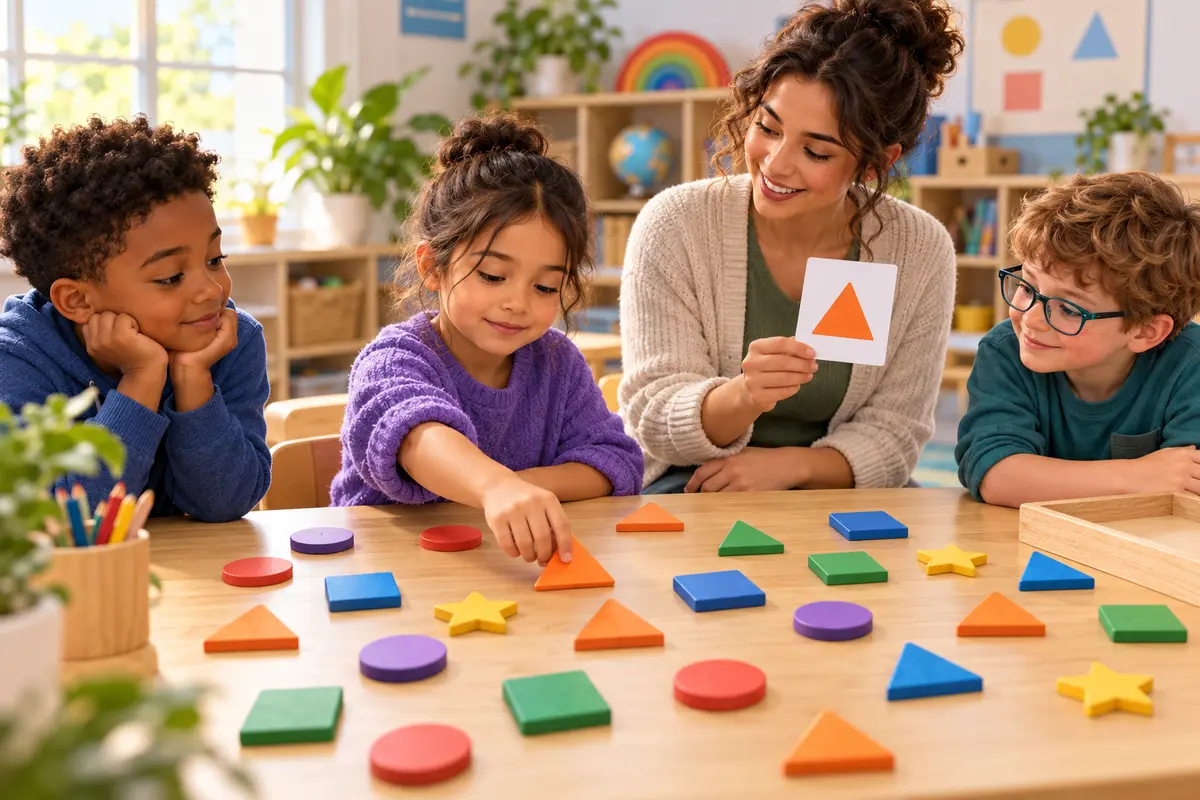
Place 10–20 blocks, cards, or household objects on a table. Choose a target with two features, such as small and red. The child collects matches and explains each choice. Make it harder by adding objects that share only one feature.
2. Sound detective
Name a target sound before reading a short paragraph aloud. The child taps once when hearing it. For younger children, use an animal word; for older students, use a transition word such as however or a key science term.
3. Category catch
Say a mixed list of words. The child catches only items in a stated category—foods, multiples of three, verbs, or renewable resources. Afterward, ask which near-match was hardest to ignore.
4. Find the rule breaker
Display a row in which most items follow one rule and one does not. Examples include capital letters among lowercase letters, an odd number among evens, or a sentence that does not support the main idea. Let the child state the rule before identifying the exception.
5. Row-by-row visual scan
Use a page of symbols, words, or numbers. Cover all but one row with a blank sheet, move downward, and mark the target. Gradually reveal more rows. This adapts the same strategy used in visual scanning activities.
6. Distraction lab
For grades 3–8, complete the same brief task under two reasonable conditions—for example, a clear desk and a desk with unused materials nearby. Compare accuracy and effort without declaring one setup universally best. Use the result to improve a focus-friendly study space.
7. Focus switch
Sort cards by color for one round, then by shape for the next. Say the new rule, pause, and begin. Switching the target adds mental flexibility; keep the materials familiar so the rule change is the only new challenge.
Adjust the challenge by grade
| Grade band | Useful targets | How to adjust |
|---|---|---|
| K–2 | One color, shape, sound, or movement | Use visible examples, few items, and short rounds. |
| 3–5 | Two features, categories, key words, or number properties | Add near-matches and ask for a strategy explanation. |
| 6–8 | Evidence, relevant data, exceptions, or changing rules | Use authentic school material and let students compare work conditions. |
The 2024 What Works Clearinghouse practice guide recommends teaching and modeling clear expectations and using reminders before situations where support is needed. For an attention activity, that means explaining what “ready” looks like before the round instead of correcting every distraction afterward.
Keep practice supportive
Increase only one variable at a time: more items, a subtler target, a longer round, or one added distraction. If accuracy drops sharply, return to the last successful level. A short movement break can also separate rounds when energy is fading.
Avoid using these games to diagnose a child. Attention varies with sleep, stress, interest, task difficulty, language demands, and environment. The American Psychological Association's educator resource emphasizes looking at patterns and educational impact rather than treating a single behavior as the whole story.
How FocusPlay fits
Well-designed learning games give children a clear goal, immediate choices, and repeated chances to notice relevant information. On FocusPlay, adults can select short, grade-aware activities and follow them with one reflection question: “What clue helped you decide?” The goal is thoughtful practice, not uninterrupted screen time.
Explore FocusPlay learning gamesFrequently asked questions
What is selective attention in children?
Selective attention is the ability to prioritize information that matters for the current task while letting competing sights, sounds, or thoughts stay in the background.
How long should an attention activity last?
Start with a brief round the child can complete successfully. End while the rules are still clear, then increase the number of targets, time, or distractions gradually instead of using one fixed duration for every child.
Should the room be completely quiet?
Not always. A calm setting can help when a task is new, but the long-term goal is to choose useful information in realistic settings. Add one manageable distraction only after the child understands the target and rule.
When does distractibility need professional attention?
Consider speaking with the child's teacher, pediatrician, or another qualified professional when attention difficulties are persistent across settings or regularly interfere with safety, learning, relationships, or daily routines.
Sources
- Center on the Developing Child at Harvard University: Brain-Building Through Play
- Center on the Developing Child: Executive Function Activities Guide
- Institute of Education Sciences: Teacher-Delivered Behavioral Interventions in Grades K–5
- American Psychological Association: Students Experiencing Inattention and Distractibility