Spatial Reasoning Activities for Kids: A K–8 Guide
When children turn a puzzle piece, picture a route, build from a model, or imagine a folded shape opening, they are reasoning about space.
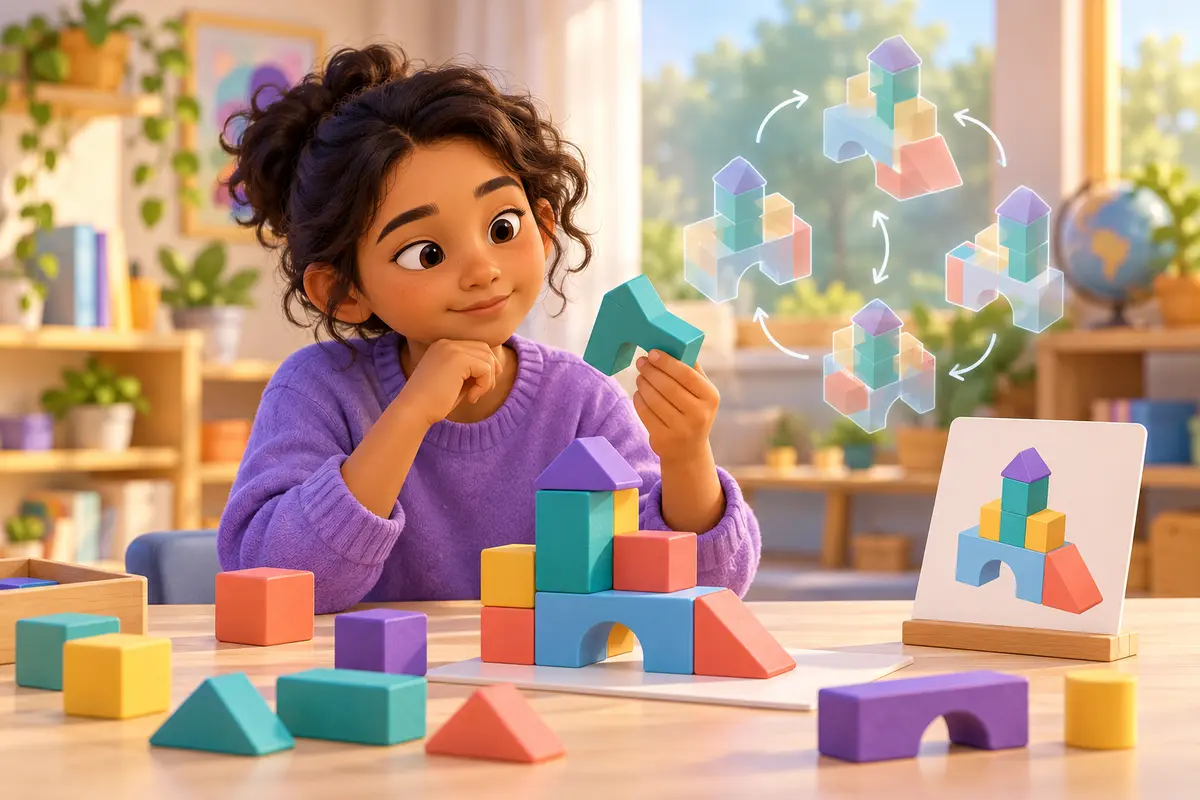
Key takeaways
- Use real objects before expecting children to rotate or transform shapes entirely in their minds.
- Ask children to name position, direction, and what stayed the same after a change.
- Include maps, construction, folding, drawing, and movement—not only flat shape worksheets.
- Adjust one variable at a time: number of pieces, viewpoint, hidden information, or number of transformations.
What does spatial reasoning include?
Spatial reasoning is thinking about shape, location, orientation, distance, movement, and perspective. It appears when a learner notices that a triangle is still a triangle after rotation, predicts which blocks will complete a structure, follows “two steps east, then turn left,” or draws what an object may look like from above.
The National Council of Teachers of Mathematics geometry standard places spatial relationships, transformations, visualization, position, and geometric modeling within mathematics from prekindergarten through grade 12. A National Academies summary on early learning also notes that young children explore patterns, shapes, and spatial relations during free play. The practical lesson is simple: spatial thinking belongs in everyday learning, not only in a geometry unit.
Use Look–Turn–Build–Explain–Change
1. Look for defining features
Before moving anything, ask what matters: number of blocks, straight or curved edges, position of an opening, equal lengths, or which pieces touch. This gives the child landmarks to track.
2. Turn or transform
Rotate, slide, flip, fold, enlarge, or change viewpoint. Name the action accurately. A turn is not the same as a flip, and moving an object does not change its size or shape.
3. Build or match
Use blocks, paper shapes, tiles, drawings, or body positions to reproduce the target. Our guide to math manipulatives can help connect a physical model to a sketch and then to symbols.
4. Explain the relationship
Ask for a short spatial statement: “The arch is under the tall block,” “I turned the piece a quarter turn,” or “The top view hides the red cube.” Precise language makes the reasoning easier to inspect.
5. Change one feature
Move one piece, hide one view, add a turn, or ask for a new route. A small change keeps the core relationship visible while increasing the challenge.
Seven spatial reasoning activities
1. Build from one view
Show a small block structure from the front. Let the child recreate it, then compare side and top views. Ask whether a different structure could produce the same front view.
2. Rotation match
Place one shape card as the target and several rotated or reflected choices nearby. The child may turn a real copy before choosing, then explain which feature confirmed the match.
3. Make and remake a shape
Cover an outline with two or more pieces. Rearrange the same pieces into a new figure. This connects naturally to pattern and structure activities.
4. Predict a paper fold
Fold paper once and mark or punch one safe spot with adult supervision. Before opening it, predict where the mark will appear. Begin with one fold, then add a second.
5. Map a route
Create a route across a room, grid, or playground. One person gives directions using landmarks and turns; the other follows, checks, and revises unclear instructions.
6. Describe a hidden arrangement
Partners use identical blocks with a divider between them. One builds and describes; the other recreates without looking. Compare the structures and improve the spatial language.
7. Draw another viewpoint
Build a simple object and sketch it from the front, side, or above. Older learners can predict a missing view or decide which details will be hidden.
Adjust the challenge by grade band
| Grade band | Start with | Increase challenge by |
|---|---|---|
| K–2 | Three to five large pieces, position words, copying, and physical turns | Hiding one piece or asking for a simple route |
| 3–5 | Multiple views, grids, symmetry, paper folding, and composed shapes | Adding distractors, two transformations, or a missing view |
| 6–8 | Scale drawings, coordinates, nets, cross-sections, and perspective | Justifying whether two constructions or routes are equivalent |
IES-supported projects have examined spatial learning through modeling and feedback, gesture, spatial language, and concrete or digital materials in preschool, as well as the development of three-dimensional spatial skills in elementary grades. These projects should not be read as one universal program, but they highlight useful dimensions adults can observe and vary. See the IES pages on preschool spatial training and 3-D spatial skills in elementary school.
Coach the reasoning, not just the answer
Avoid taking the piece and placing it correctly. Offer a smaller cue: identify an anchor, trace an edge, rotate the base, or compare one side. If a task depends heavily on color, drawing, or vision, provide tactile pieces, high contrast, verbal directions, or movement so the learner can access the spatial relationship.
Also separate spatial difficulty from speed. A child may reason accurately while needing time to inspect a complex view. Keep early rounds untimed, accept gestures and models as explanations, and save speed for situations where it is genuinely part of the goal.
How FocusPlay fits
FocusPlay activities can provide short opportunities to rotate, classify, plan routes, and recognize structure. Pair a digital round with a physical object or quick sketch, then ask the child to explain one move. For more varied reasoning prompts, explore our logic games guide.
Explore FocusPlay learning gamesFrequently asked questions
What is spatial reasoning for kids?
Spatial reasoning is the ability to think about shapes, positions, distances, directions, and how objects look or fit when they move, turn, combine, or separate.
Is spatial reasoning the same as eyesight?
No. Eyesight is visual access; spatial reasoning is thinking about relationships in space. A child can reason spatially through touch, movement, spoken directions, models, or accessible graphics as well as through vision.
Which activities help children practice spatial reasoning?
Useful activities include building from a model, rotating shapes, composing and decomposing figures, predicting paper folds, following or creating maps, describing hidden arrangements, and drawing an object from another viewpoint.
What if a child struggles to rotate shapes mentally?
Let the child rotate a real object first, compare one feature at a time, and describe what stays the same. Move gradually from hands-on turning to a picture and then to an imagined turn.