Gifted Testing for Kids: How Schools Identify Students
A gifted test is rarely one test. It is a series of steps a district uses to decide which students need more advanced learning—and knowing those steps makes the process far less mysterious.

Key takeaways
- There is no single national gifted test; each state and district sets its own process.
- Most processes have four stages: screening, further testing, a review of evidence, and a decision.
- A percentile rank is a comparison with other children, not a percent of questions answered correctly.
- Screening every student, rather than waiting for referrals, has been linked to more low-income, Black, and Hispanic students being identified.
- The best preparation is familiarity and rest, not weeks of drilling.
What “gifted testing” usually means
Parents often hear “the gifted test” as if there were one exam every school uses. In practice, identification is a set of steps chosen by a state or district. New Jersey’s guidance, for example, says districts “must use multiple measures” and that no single assessment result should disqualify a student. North Carolina’s program standards say that “No one criterion should exclude a child” from identification. Other states use different language, cutoffs, and program names, such as GATE, AIG, or highly capable.
So when a school says your child will be “tested for gifted,” it helps to ask which stage this is and what other information will be used. A screener in second grade, an individual test with a psychologist, and a teacher rating scale are all part of “gifted testing,” but they answer different questions.
How the identification process usually works
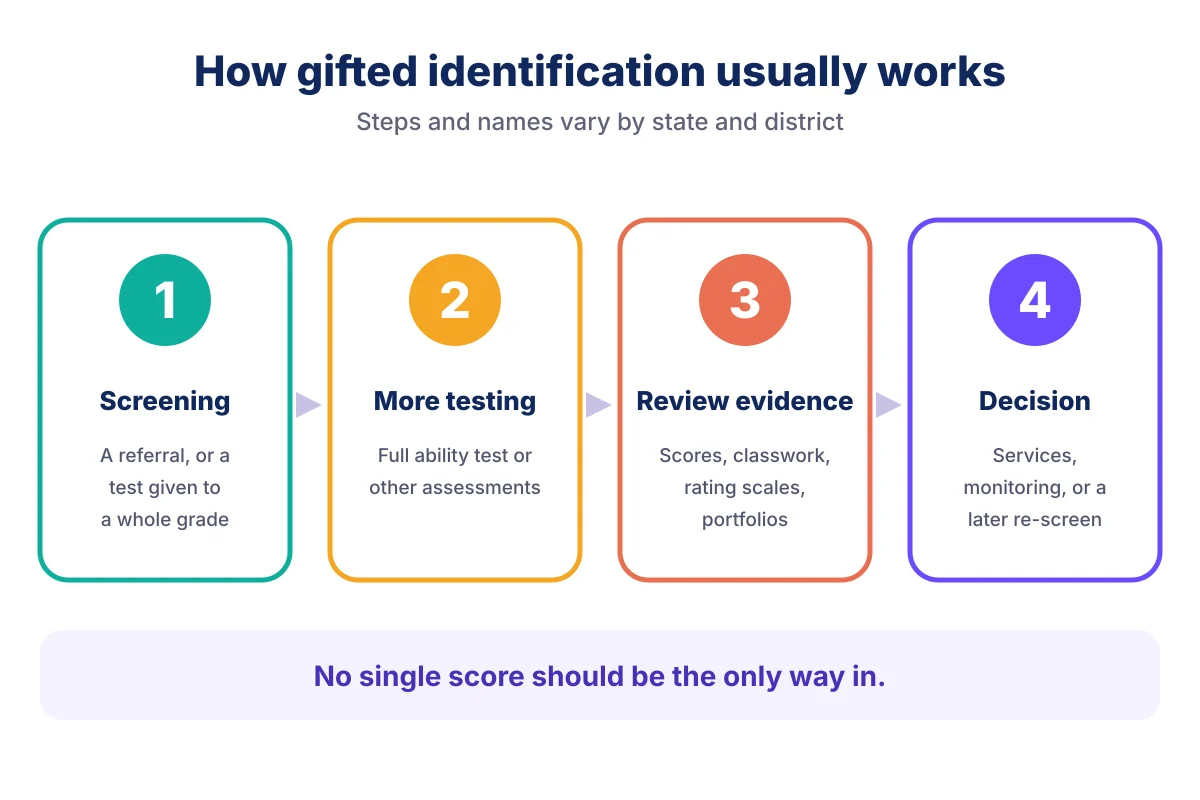
1. Screening
Screening decides who gets a closer look. In some districts, a parent or teacher refers a child. In others, every student in a grade takes a short test; this is called universal screening. North Carolina’s standards describe universal screeners and also recommend several screening windows during the year, so a child who is missed once has another chance.
2. Further testing
Students who pass the screener may take a fuller ability test, an achievement test, or both. Some districts also accept or give individually administered intelligence tests, such as the WISC-V, especially for students who receive special education services.
3. Review of evidence
A committee looks at test results alongside other information: grades and work samples, teacher or parent rating scales, and sometimes a portfolio. New Jersey’s guidance describes teacher rating scales as a safety net for catching students other measures miss, and warns against using them to exclude children.
4. Decision
The result might be placement in a program, services in one subject, continued monitoring, or a recommendation to re-screen later. Ask what each outcome means for your child’s daily schedule, because “identified” can look very different from one district to another.
The main kinds of measures
| Measure | What it looks at | Who usually gives it | Examples |
|---|---|---|---|
| Group ability (reasoning) test | Verbal, quantitative, and nonverbal reasoning rather than taught content | The school, often for a whole class or grade | CogAT, NNAT |
| Individual intelligence test | A broader profile of reasoning, memory, and processing | A licensed psychologist, one child at a time | WISC-V and similar tests |
| Achievement or growth test | What a child already knows in reading and math | The school, often already part of the calendar | State tests, adaptive tests such as MAP Growth |
| Rating scales and checklists | Behaviors adults notice, such as curiosity, reasoning, and motivation | Teachers, sometimes parents | District or published scales |
| Portfolio or performance task | Work that shows advanced thinking or a talent | Student work collected by teachers or families | Writing, projects, math explanations |
Ability tests and achievement tests are often confused. An ability test asks a child to reason with new material, such as finding a rule in a pattern. An achievement test asks what the child has already learned. Many districts use both because some children show advanced reasoning before their schoolwork catches up, and others show advanced achievement that a reasoning test does not capture.
How to read gifted test scores
Most score reports include a percentile rank. It compares your child with a norm group of the same age or grade. Riverside Insights, which publishes the CogAT, explains that “A PR of 50 is considered average.” A percentile rank of 95 does not mean 95 percent of questions were correct; it means the child scored as high as or higher than most children in the comparison group.
Percentiles are bunched near the top. Riverside notes that the difference between the 50th and 55th percentiles is small, while the gap between the 90th and 95th is large. That is why two children with similar abilities can land a few percentile points apart, and why a cutoff such as “95th percentile” can feel arbitrary to families just below it.
Some tests also report a standard score. On the CogAT, the Standard Age Score has a mean of 100 and a standard deviation of 16. Other tests use different scales, so a 130 on one test is not automatically equal to a 130 on another.
National norms and local norms
A national norm compares a child with students across the country. A local norm compares the child with students in the same district or school. A research team analyzing MAP Growth data from more than 3 million students found that local norms made gifted groups more representative. In their sample, Black students made up about 2% of students identified with national norms but about 8% with local norms; for Latinx students the shares were about 3% and 9% (AERA Open, 2019; summarized in a Texas Association for the Gifted and Talented presentation). The effect depends on how different schools are from each other, but it explains why some districts now use both.
Why universal screening matters
Referral-based systems depend on someone noticing a child. A study of a large Florida district found that when the district began screening all second graders with a nonverbal ability test, identification rose sharply for students from low-income families, English learners, and Black and Hispanic students. The authors concluded that these groups had been “underreferred” under the parent-and-teacher referral system (Card and Giuliano, PNAS, 2016). A separate study in rural districts that screened every second grader and used local norms identified a larger share of minority students than the districts’ usual process, as summarized by the Thomas B. Fordham Institute.
If your district screens everyone, your child will likely be included automatically. If it relies on referrals, ask how to request testing and whether there is a deadline.
A quick look at question types
Many reasoning tests use short visual and number puzzles. Two original examples are below so you can see the general style. For a full set organized by subtest, see our CogAT guide for parents.
Practice questions in a similar style
These questions were written by FocusPlay as original practice in a similar style. They are not real test items, they are not taken from any test publisher or prep book, and they should not be used to predict a score. Use them for short, playful familiarity with the format.
1. Figure Matrices
Read aloud: “Look at the top row. The first picture changes into the second. Find the picture that changes the bottom row in the same way.”
Text description: Top row: white triangle → black triangle. Bottom row: white star → ?. Choices: A white star, B black star, C black triangle, D white circle.
Show answer
Answer: B — black star. In the top row the shape stays the same and turns from white to black. The star should do the same, so the answer is a black star.
2. Number Series
Read aloud: “What number comes next?”
20, 17, 14, 11, ?
- A. 9
- B. 10
- C. 8
- D. 7
Show answer
Answer: C — 8. Each number is 3 less than the one before it: 11 − 3 = 8.
How to prepare without over-preparing
A little familiarity helps a child understand what to do. Heavy drilling, on the other hand, can create stress and can make a score less useful for finding the right level of challenge. Riverside’s own materials say that “excessive preparation or coaching will have reduced impact” on CogAT results, and its planning guide recommends that either all students in a group get the practice activities or none do.
- Explain the format. Tell your child there will be puzzles with pictures, words, or numbers, and that nobody is expected to know every answer.
- Practice listening to directions. Young children often lose points by rushing before the question is finished.
- Play reasoning games. Everyday puzzles build the same habits: noticing rules, comparing, and checking. Our guides to pattern recognition activities, spatial reasoning, and logic games have ideas, and our free printable worksheets include pattern and visual-logic pages.
- Protect sleep and breakfast. A rested child shows what they can do.
- Keep the stakes low. Say “This helps your teacher find good challenges for you,” not “This decides your future.”
Questions to ask your school
- Which tests are used at each stage, and in which grades?
- Are scores compared with national norms, local norms, or both?
- What other evidence is reviewed, and can families submit work samples?
- Is there a second screening window, a retest policy, or an appeal process?
- What services does an identified student actually receive?
- How are English learners and students with disabilities supported during testing?
Special situations
English learners. Some tests offer directions in more than one language; the CogAT, for instance, provides directions in English and Spanish at all levels. Nonverbal tests reduce the language load but do not remove every barrier, so local norms and multiple measures still matter.
Twice-exceptional (2e) learners. A child can be advanced in reasoning and also have a learning disability, ADHD, or another need. Their scores may look uneven. Ask whether the district considers individual testing or other evidence for students with an IEP or 504 plan.
If your child is not identified. It is not a verdict on your child’s potential. Ask whether there is another screening window, what evidence was missing, and how the classroom can provide challenge in the meantime.
Frequently asked questions
What test is used for gifted identification?
It depends on the district. Many use a group reasoning test such as the CogAT or NNAT, often with an achievement test, teacher rating scales, or work samples. Some also accept an individual test given by a psychologist.
What percentile counts as gifted?
There is no national cutoff. Districts set their own criteria, and many combine several measures or use local norms. Ask your district for its current rules rather than relying on a number you saw online.
Is a percentile rank the same as a percentage correct?
No. A percentile rank compares a child with others of the same age or grade. A percentile rank of 90 means the child scored as high as or higher than most children in that comparison group, not that they answered 90 percent of questions correctly.
Should I prepare my child for a gifted test?
Light familiarity helps: explain the format, try a few sample puzzles, and protect sleep. Heavy drilling can add stress and may make results less useful for finding the right level of challenge.
What is universal screening?
Universal screening means testing every student in a grade instead of only those who are referred. Research in a large Florida district found it increased identification of low-income, Black, and Hispanic students and English learners.
Sources
- New Jersey Department of Education: Gifted and Talented best practices for identification
- North Carolina DPI: Unpacking the NC AIG Program Standards (2021)
- Riverside Insights: CogAT types of scores
- Riverside Insights: Introducing CogAT Form 8
- Riverside Insights: CogAT Forms 7 and 8 product planning guide
- Card & Giuliano (2016), Universal screening increases the representation of low-income and minority students in gifted education, PNAS
- Peters et al. (2019), Effect of local norms on racial and ethnic representation in gifted education, AERA Open
- Texas Association for the Gifted and Talented: Local norms presentation (2020)
- Thomas B. Fordham Institute: The benefits of multiple screenings for student giftedness
Last updated: November 6, 2026. This article is for information only and is not affiliated with or endorsed by the test publishers. Testing rules change; confirm current details with your school or district.
Explore Focusplay learning games