What Is the CogAT Test? A Parent’s Guide to Levels, Scores, and Practice
Many schools use the CogAT when they look for students who need extra challenge. Here is what it measures, how it is organized, what the scores mean, and what its question types look like.
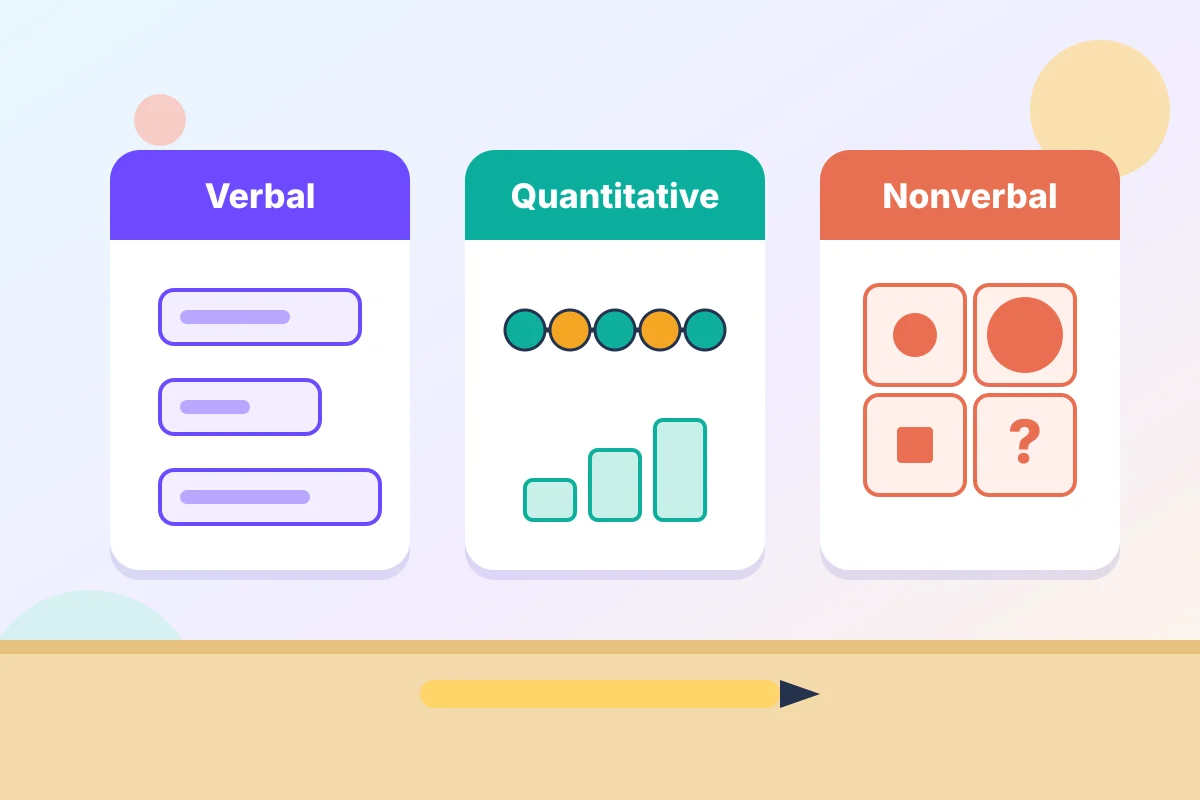
- Publisher
- Riverside Insights
- Grades
- Kindergarten–Grade 12, across ten test levels
- Batteries
- Verbal, Quantitative, Nonverbal (nine subtests in total)
- Short version
- CogAT Screener: one subtest from each battery, one combined score
- Timing
- Levels 9 and up: ten minutes per subtest; younger levels follow the administration directions
- Format
- Online or paper; directions in English and Spanish at all levels
- Current forms
- Form 7 and Form 8, designed to be interchangeable
- Main scores
- Standard Age Score (mean 100), age and grade percentile ranks, stanines, Ability Profile
- Who gives it
- Schools and districts, usually in a classroom group
What the CogAT measures
The CogAT is designed to measure reasoning—how well a child can find relationships, apply rules, and solve new problems—in three areas: words, numbers, and shapes. Riverside describes it as capturing information “not represented in report card grades” or in other achievement measures. Schools use it to plan instruction and to spot students whose reasoning may be ahead of their classwork.
The three batteries and nine subtests
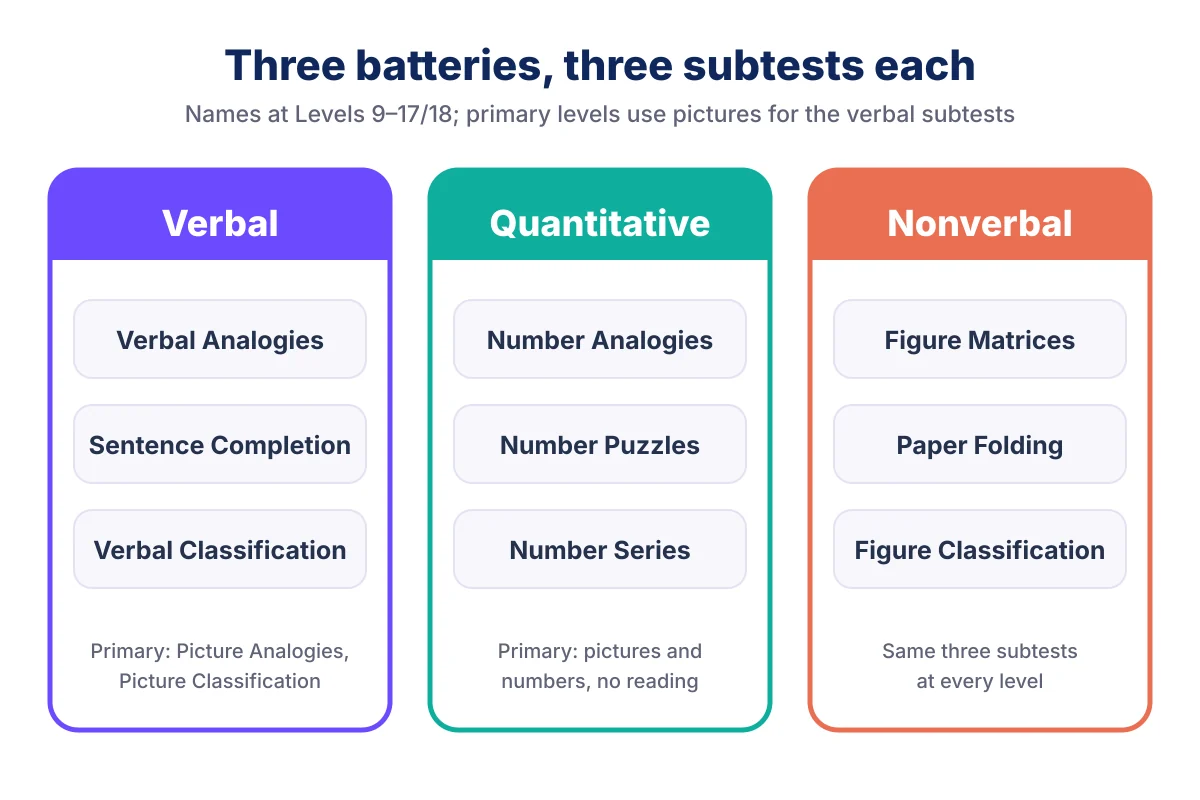
According to Riverside’s description of the test structure, each battery includes three subtests. The names differ slightly between the primary levels (5/6–8) and the upper levels (9–17/18), as summarized in Riverside’s product planning guide.
| Battery | Levels 5/6–8 (K–2) | Levels 9–17/18 (Grades 3–12) |
|---|---|---|
| Verbal | Picture Analogies, Sentence Completion (optional), Picture Classification | Verbal Analogies, Sentence Completion, Verbal Classification |
| Quantitative | Number Analogies, Number Puzzles, Number Series (pictorial) | Number Analogies, Number Puzzles, Number Series |
| Nonverbal | Figure Matrices, Paper Folding, Figure Classification | Figure Matrices, Paper Folding, Figure Classification |
Verbal battery
Verbal subtests ask how words or pictures are related. At the youngest levels, Riverside notes that questions are “entirely pictorial” and require no reading, apart from the optional Sentence Completion subtest, in which the teacher reads the question aloud.
Quantitative battery
Quantitative subtests focus on number relationships: a rule that turns one number into another, an equation to balance, or the next step in a series.
Nonverbal battery
Nonverbal subtests use shapes only. They ask how a design changes across a grid, where holes appear when punched paper is unfolded, and which figure shares a group’s rule. These items rely less on language, though children still need to understand the directions.
CogAT levels by grade
The ten levels of CogAT span kindergarten through grade 12. Levels 5/6–8 are designed for kindergarten through grade 2, and Levels 9–17/18 for grades 3–12. The table shows the typical match; a school can choose a different level for a particular group.
| Level | Typical grade | What it looks like |
|---|---|---|
| 5/6 | Kindergarten | Pictures, directions read aloud or played as audio |
| 7 | Grade 1 | Pictures, no reading required |
| 8 | Grade 2 | Pictures, no reading required |
| 9–12 | Grades 3–6 | Words and numbers; ten minutes per subtest |
| 13/14–17/18 | Grades 7–12 | Same nine subtests at greater difficulty |
Schools can test online, with audio directions, or on paper.
The full CogAT vs. the CogAT Screener
Some districts give the shorter CogAT Screener to a whole grade and the full test only to students who pass it. The Screener includes one subtest from each battery: Picture or Verbal Analogies, Number Analogies, and Figure Matrices. It reports a single score rather than separate battery scores, because three subtests are not enough for reliable battery-level results.
Riverside advises that a Screener cut score “should always be more generous” than the cut score on the full test, so that the screener lets possible candidates through rather than screening them out. For schools testing online, the remaining six subtests can be given later as a “Post-Screener” to complete the full test.
Form 7 and Form 8
Form 8 is an equivalent version of Form 7. Riverside says it has the same specifications and item types, but the items themselves are entirely unique. The two forms use the same scales and norms and can be used interchangeably, which lets districts alternate forms between years.
How to read a CogAT score report
Reports vary by district, but most include these scores, explained in Riverside’s guide to score types:
- Standard Age Score (SAS): compares the child with others of the same age. It has a mean of 100 and a standard deviation of 16, and on Forms 7 and 8 it ranges from 50 to 160.
- Percentile rank (age and grade): where the child stands compared with the same age group or grade group. A percentile rank of 50 is average.
- Stanine: a broad band from 1 (lowest) to 9 (highest). Riverside notes that broad groupings discourage over-interpretation of small differences.
- Universal Scale Score (USS): a developmental scale used to look up the other scores.
- Ability Profile: a short code such as “7C (V+ Q–).” The number is a 1–9 summary level, the letter describes how even or uneven the three battery scores are, and the symbols mark relative strengths or weaknesses. In Riverside’s sample report, an “A” profile goes with battery scores that “do not differ significantly.”
Some districts also report local percentile ranks and stanines, comparing your child with students in the same district. Our guide to gifted testing for parents explains percentiles, local norms, and the wider identification process in more detail.
Practice questions in a similar style
These questions were written by FocusPlay as original practice in a similar style. They are not real test items, they are not taken from any test publisher or prep book, and they should not be used to predict a score. Use them for short, playful familiarity with the format.
There is one question for each of the nine subtest types. Young children can do the picture questions with an adult reading the directions; older children can try all nine.
1. Verbal Analogies
Read aloud: “The first two words go together. Pick the word that goes with the third word in the same way.”
glove → hand :: sock → ?
- A. shoe
- B. foot
- C. knee
- D. wool
Show answer
Answer: B — foot. A glove is worn on a hand. A sock is worn on a foot. A shoe is also worn, but it is not a body part, so it does not match the relationship.
2. Sentence Completion
Read aloud: “Listen to the sentence and choose the word that makes the most sense.”
Maya put on her raincoat because the sky was full of dark ____.
- A. stars
- B. birds
- C. kites
- D. clouds
Show answer
Answer: D — clouds. Dark clouds can mean rain is coming, which explains the raincoat. The other words do not explain why she needs a raincoat.
3. Verbal Classification
Read aloud: “These three words go together: carrot, potato, beet. Which word belongs with them?”
carrot · potato · beet
- A. radish
- B. banana
- C. daisy
- D. cheese
Show answer
Answer: A — radish. Carrots, potatoes, and beets are vegetables that grow underground. A radish is too. A banana is a fruit, a daisy is a flower, and cheese is made from milk.
4. Number Analogies
Read aloud: “Find the rule that changes each first number into the second number. Use the same rule on the last number.”
[3 → 6] [5 → 10] [7 → ?]
- A. 12
- B. 9
- C. 14
- D. 21
Show answer
Answer: C — 14. Each number is doubled: 3 × 2 = 6 and 5 × 2 = 10, so 7 × 2 = 14. Adding the same amount would not work for both pairs.
5. Number Puzzles
Read aloud: “Both sides must be equal. What number belongs in the box?”
? + 4 = 6 + 5
- A. 5
- B. 7
- C. 9
- D. 11
Show answer
Answer: B — 7. The right side is 6 + 5 = 11. The missing number plus 4 must also equal 11, so it is 7.
6. Number Series
Read aloud: “What number comes next?”
2, 5, 8, 11, ?
- A. 13
- B. 15
- C. 16
- D. 14
Show answer
Answer: D — 14. The numbers go up by 3 each time: 11 + 3 = 14.
7. Figure Matrices
Read aloud: “The top row shows a change. Find the picture that makes the bottom row change the same way.”
Text description: Top row: small circle → large circle. Bottom row: small square → ?. Choices: A small square, B large circle, C large square, D large triangle.
Show answer
Answer: C — large square. In the top row the shape stays the same but gets bigger. The small square should become a large square.
8. Paper Folding
Read aloud: “A square sheet of paper is folded in half, and one hole is punched through it. What will it look like when it is unfolded?”
Text description: The left half is folded over onto the right half, then one hole is punched near the top of the folded sheet. Choices: A two holes near the top, one on each side of the fold; B one hole top right; C two holes on the right side; D two holes near the bottom.
Show answer
Answer: A — two holes at the top, one on each side. The punch goes through two layers. When the paper is opened, the second hole appears in the mirror position on the other side of the fold, at the same height.
9. Figure Classification
Read aloud: “The top three shapes are alike in some way. Which answer choice belongs with them?”
Text description: Given: a rectangle, a diamond, and a parallelogram. Choices: A triangle, B circle, C pentagon, D trapezoid.
Show answer
Answer: D — trapezoid. Every top shape has four straight sides, even though they look different. The trapezoid is the only choice with four sides.
Preparing for the CogAT at home
Riverside provides practice activities to schools and recommends that either everyone in a testing group uses them or no one does, so results stay comparable. It also notes that excessive coaching has reduced impact on scores. A sensible home plan is short and low-key:
- Try a few sample questions like the ones above, and practice reading every answer choice before choosing.
- Build reasoning through play: analogies in conversation (“A cub is to a bear as a kitten is to…?”), vocabulary games, number sense activities, and spatial reasoning activities such as folding and cutting paper.
- FocusPlay’s learning games and free worksheets include pattern, logic, and visual-reasoning practice that fits naturally into short sessions.
- Keep the message calm: the test helps teachers choose good challenges.
If you have questions about your child’s report, ask the school which norm group was used, whether your child took the full test or the Screener, and what other information goes into placement decisions.
Frequently asked questions
What does the CogAT test measure?
The CogAT measures reasoning in three areas: verbal, quantitative, and nonverbal. It looks at how children find relationships and apply rules to new problems, rather than what they have already learned in class.
How long is the CogAT?
At Levels 9 and above, each subtest is timed at ten minutes, so the nine subtests take about 90 minutes of testing time plus directions. Schools set the schedule for younger levels and may spread testing across more than one session.
What is a good CogAT score?
A Standard Age Score of 100 or a percentile rank of 50 is average for the child’s age. Gifted programs set their own criteria, so a “qualifying” score depends on the district and may use local norms.
What is the difference between the CogAT and the CogAT Screener?
The full CogAT has nine subtests and reports battery scores. The Screener uses three of them—one from each battery—and reports one combined score, so districts can screen a whole grade quickly before giving the full test.
Can you study for the CogAT?
A little familiarity with the question types helps children understand the directions. Riverside notes that excessive coaching has reduced impact, so short, low-pressure practice and reasoning games are a better fit than intensive drilling.
Is the CogAT an IQ test?
Not exactly. It is a group reasoning test given by schools. Its Standard Age Score uses a similar scale, but it is not the same as an individual intelligence test given by a psychologist, and the scores should not be treated as equivalent.
Sources
- Riverside Insights: Structure of the CogAT assessment
- Riverside Insights: CogAT Forms 7 and 8 product planning guide
- Riverside Insights: Introducing CogAT Form 8
- Riverside Insights: CogAT types of scores
- Riverside Insights: Individual Profile Narrative report guide
- Thomas B. Fordham Institute: The benefits of multiple screenings for student giftedness
Last updated: November 6, 2026. This article is for information only and is not affiliated with or endorsed by the test publishers. Testing rules change; confirm current details with your school or district.
Explore Focusplay learning games